|
Uterine
Fibroid Embolization
|
| Portland
Providence Medical Center, Portland |
| Portland
Endovascular Interventional Radiology Center (PERC) |
| Orhan
Konez, MD, Interventional Radiologist |
|
Consultation
- Scheduling: (503) 731 - 2900 |
|
What
are uterine fibroids?
They
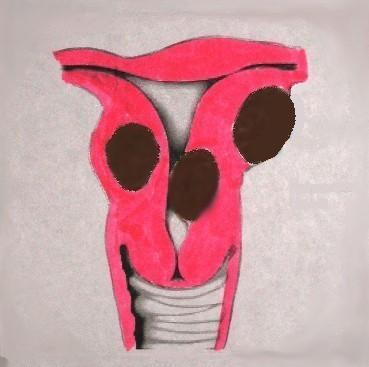
are very common non-cancerous (benign) growths that develop in
the muscular wall of the uterus, ranging in size from very
tiny to larger than a cantaloupe. In some, they can cause the
uterus to grow in the size of a five-month pregnancy or more.
They are commonly found in women in their 30s and 40s.
How
common are these tumors?
20-40 percent of women
age 35 and older have uterine fibroids of a significant size.
African American women are at higher risk for fibroids: as
many as 50% have fibroids of a significant size. |
|
|
 |
What
are the symptoms?
Most
fibroids don't cause symptoms — only 10 percent to 20 percent of
women who have fibroids ever require treatment. Depending on
location, size and number of fibroids, a woman might experience the
following:
-
Heavy,
prolonged menstrual periods and unusual bleeding, often leading
to anemia
-
Pelvic
pain
-
Pelvic
pressure or heaviness caused by the bulk or weight of fibroids
-
Pain
in the back or legs as the fibroids press on nerves that supply
the pelvis and legs
-
Pain
during sexual intercourse
-
Bladder
pressure leading to a constant urgef to urinate
-
Pressure
on the bowel, leading to constipation and bloating
-
Abnormally
enlarged abdomen
Are
there different types of fibroids?
There
are 3 primary types:
- Subserosal:
These develop under the outside covering of the uterus and
expand outward. They typically do not effect menstrual
flow, but can cause pain and pressure.
- Intramural:
They develop within the lining of the uterus and expand
inward. These are the most common fibroids and can result
in heavier menstrual bleeding and pelvic pain, back pain
or generalized pressure.
- Submucosal:
These are just under the lining of the uterus and the
least common fibroids. However, they tend to cause the
most problems; even a tiny submucosal fibroid can cause
heavy bleeding - gushing, very heavy and prolonged
periods.
|
|
 |
How
to make diagnosis?
Typically,
fibroids are first diagnosed during a gynecologic internal
examination. Your doctor will conduct a pelvic exam to feel if your
uterus is enlarged. The presence of fibroids is most often confirmed
by an abdominal ultrasound. In some cases, a transvaginal
ultrasonography may be necessary. Fibroids also can be confirmed
using magnetic resonance imaging (MRI) and computed tomography (CT)
imaging techniques.
Any
changes in uterine fibroids with pregnancy or menopause?
Fibroids
can dramatically increase in size during pregnancy. This is thought
to occur because of the increase in estrogen levels during
pregnancy. After pregnancy, the fibroids usually shrink back to
their pre-pregnancy size. They typically improve after menopause
when the level of estrogen, the female hormone that circulates in
the blood, decreases dramatically. However, menopausal women who are
taking supplemental estrogen (hormone replacement therapy) may not
experience relief of symptoms.
What
is the treatment?
a
- Drug Therapy
b
- Surgery
(Hysterectomy or Myomectomy)
c
- Embolization
(Minimally Invasive procedure)
Symptomatic
fibroids can be treated by means of medical (medication), surgical,
or interventional measures. Medical treatment consists of the use of
several medications, eg, nonsteroidal anti-inflammatory drugs (NSAIDs),
birth control pills, gonadotropin-releasing hormone analogs (Lupron),
and antiprogesterones (RU-486). Uterine fibroids are the most
frequent indication for hysterectomy in pre-menopausal women and,
therefore, are a major public health issue. Of the 600,000
hysterectomies performed annually in the United States, 1/3 of these
are due to fibroids. Surgical
treatment of fibroids includes hysterectomy or myomectomy, both of
which require general anesthesia and hospitalization. A myomectomy
is a local treatment and has a high recurrence rate.
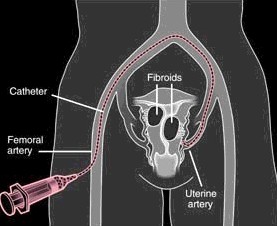
Transcatheter
embolotherapy is a well recognized therapeutic alternative to
surgery with a high patient satisfaction rate and positive
therapeutic results. This approach to the treatment of fibroids
blocks ther arteries that supply blood to the fibroids causing them
shrink. It is a minimally invasive procedure, requiring only a tiny
nick in the skin, and is performed while the patient is conscious
but sedated - feeling no pain or significant discomfort.
 |
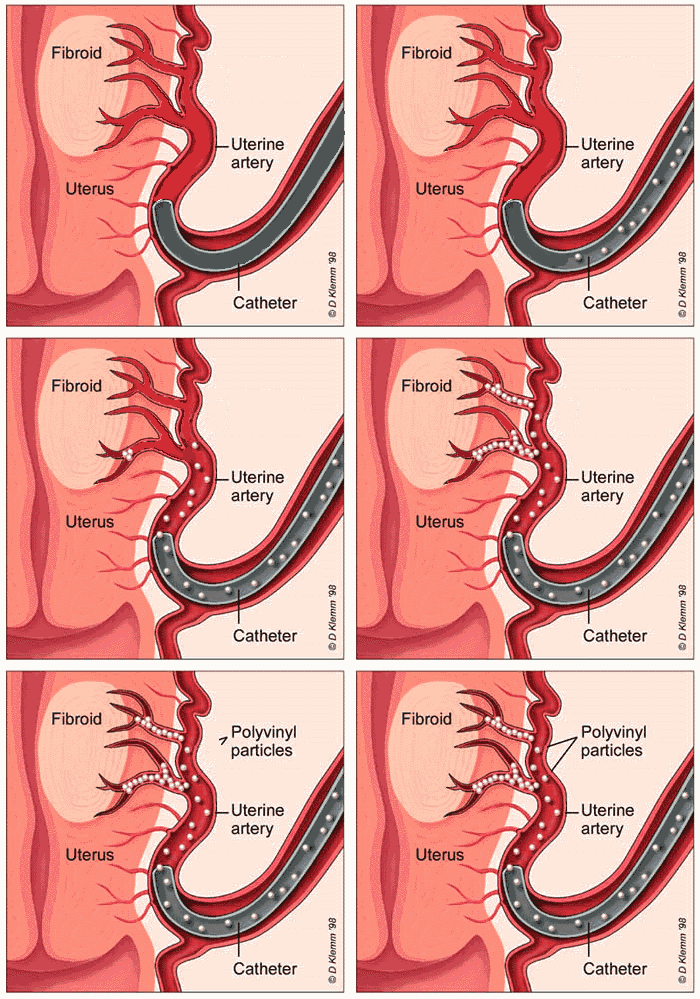
A
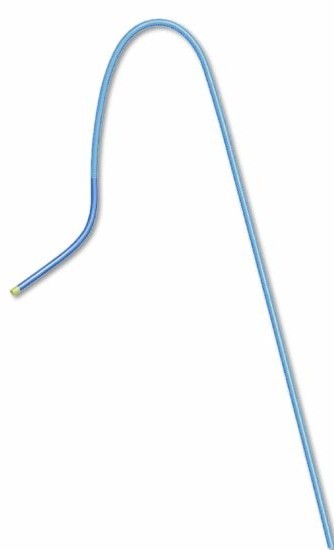
small catheter catheter is advanced into the feeding artery
during the procedure. Following angiographic evaluation, this
catheter is used to deliver tiny embolization particles. |
-
An
estimated 13,000 - 14,000 procedures are performed annually in the
U.S.
-
The embolic particles are approved by the FDA specifically for this
procedure
-
Embolization of the uterine arteries is not new, used more than 20
years to treat heavy bleeding
-
Embolization was first used as an adjunct to help decrease blood
loss during myomectomy
-
This procedure is covered by most major insurance companies
-
Most women with symptomatic fibroids are candidates for this
procedure
What
is embolization and who performs this procedure?
 |
Embolization
is the intentional blocking of an artery by injecting
particles (PVA particles or embospheres), coils or other
agents through a small plastic catheter, whose tip is placed
in the vessel to be blocked. When the catheter is positioned
in the target vessel, contrast media (a liquid which is opaque
to X-rays) is injected from the catheter to study the vessels
(angiography). When the appropriate position of the catheter
is confirmed, embolization can be performed. Embolization
procedure should be performed only by an appropriately trained
and experienced interventional radiologist; otherwise,
devastating complications may be unavoidable. |
Who
is an Interventional Radiologist?
Interventional
radiologist is a physician who has undergone specialized training
(fellowship) in the conduct of catheter-related procedures following
4 or 5 years of radiology residency. An interventional radiologist
is a board-certificated radiologist with additional board
certification for vascular and interventional procedures (Subspecialization).
What
are the embolization particles made of?

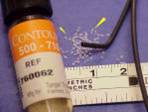
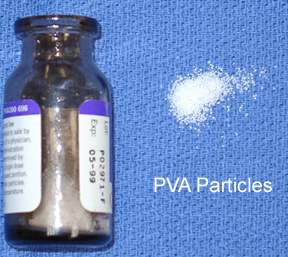
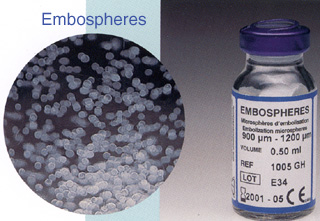
There
are two commonly used embolization particles for fibroid
embolization, PVA particles and microspheres (Embospheres). These
particles are available in various sizes. Microspheres have an
advantage of not clumping together and penetrating well into the
vessels supplying the fibroids. Microspheres are believed to be
causing more permanent blockage than PVA, although results in
patients appear quite similar(*).
Are
embolization particles toxic?
PVA
particles have been in clinical use for embolization since 1975 and
have a long track record of safety and also FDA approved for
embolization procedure. Microspheres (Embospheres) are also FDA
approved and have been in clinical use for over 10 years.
Does
embolization procedure hurt?
This
procedure is performed under local anesthesia and conscious
sedation. Main purpose of conscious sedation is to make patients
more comfortable during the procedure so that patient motion does
not interfere the precise catheterization and subsequent
embolization. The catheterization itself is essentially painless.
However, mild to moderate cramping is expected after embolization
and begins minutes to hours after the procedure. severe pain is
quite uncommon.
Do
I have to stay overnight?
We
like to deal with any problems while you are in the hospital rather
than sending you home too early. Almost all patients can go home the
next day at mid-morning. We will keep you until it is certain that
your pain is well-controlled and that you can take food and drink
without any difficulty.
What
happens after the procedure and risks?
The
first two days are the toughest. Uterine cramping is expected, but
the discomfort can be managed effectively with the medications
prescribed at the time of hospital discharge. Low fever is common
after the procedure, usually resolves after day 5 or 6. infection
is a risk after this procedure. Tenderness and cramping
slowly improve. Some spotting or discharge is common. Small tissue
fragments may be passed. During days 7 - 14, most patients feel well
enough to consider returning normal activities or regular work. The
two most significant complications are amenorrhea (3%) and fibroid
slough retention (2-3%). Embolotherapy may hasten or initiate
menopause in a perimenopausal patient whose ovaries depended on the
contribution of uterine arterial flow. You should fully understand
the nature of the procedure, including potential benefits, risks and
alternatives.
official
press releases
Any
radiation risks?
The
radiation dose varies, but is similar to standard angiographic
procedures. In general, every effort is made to minimize radiation
dose during the procedure. Typical doses are similar to those
received from two standard barium enema procedures.
Will
my insurance cover it?
This
procedure is covered by most major insurance companies. Please check
with your insurance company to confirm this.
Does
Uterine Fibroid Embolization work?
Almost
all fibroid embolization procedures are performed for excessive
bleeding, or for symptoms related to significantly large size
fibroids causing significant pelvic pressure. For excessive
bleeding, approximately 90% of patients get very good to excellent
relief of their symptoms. For pressure-related symptoms (frequent
urination, pain etc.), 85-90% get very good to excellent relief.
Who
does these procedures & How to make an appointment?
Dr.
Konez is a board-certified radiologist and is also certified for
added qualifications in vascular and interventional radiology. Dr.
Konez is considered a leader in embolization procedures among his
peers and has authored nearly 50 scientific papers and several book
chapters in the field. Dr. Konez previously worked at the
Children's Hospital Boston and BIDMC (Harvard Teaching Hospitals)
and also at the Cleveland Clinic Foundation. To see other online
chapters written by Dr. Konez, click below subtitles:
|
To
make an appointment, please call (503) 731-2900 |
| Other
Useful Sites:
|
| Disclaimer:
Information accessed
through this web page is presented in summary form and such
information is not complete and should not be used as a
substitute for a consultation or visit with your physician or
other health care provider. Information accessed through this
website is not exhaustive and does not cover every aspect of
the procedure, indications and potential risks. Dr. Konez
makes no warranty as to the information's completeness,
reliability or accuracy. Should you have any health care
related questions regarding this matter, please see your
physician or other health care provider promptly.
|
|
Oregon
Hospitals:
Adventist
Health,
Adventist Medical
Center - Portland,
Tillamook County General
Hospital - Tillamook;
Adventist Medical
Center - Portland;
Albany
General Hospital - Albany;
Asante Health System - Medford;
Rogue
Medical Center - Medford;
Three
Rivers Community Hospital - Grants
Pass; Ashland
Community Hospital - Ashland;
Bay Area Hospital - Coos
Bay; Blue
Mountain Hospital - John Day, Grant
County; Cascade
Medical Clinic - Redmond;
Casey Eye Institute -
Portland;
Central Oregon Community
Hospital - Redmond;
Coquille Valley Hospital -
Coquille; Cottage
Grove Community Hospital - Cottage
Grove; Curry
General Hospital - Gold
Beach; Doernbecher
Children's Hospital - Portland;
Eastmoreland
Hospital - Portland;
Good Shepherd Medical Center
- Hermiston; Grande
Ronde Hospital - La
Grande; Harney
District Hospital - Burns;
Holy Rosary
Medical Center - Ontario;
Hood
River Memorial Hospital - Hood
River; Kaiser
Sunnyside Medical Center - Clackamas, Clackamas
County; Lake
District Hospital - Lakeview, Lake
County; Lebanon
Community Hospital - Lebanon;
Legacy
Emanuel Children's Hospital - Portland;
Legacy
Emanuel Hospital & Health Center - Portland;
Legacy
Good Samaritan Hospital & Medical Center - Portland;
Legacy Health System -
Portland;
Legacy
Emanuel Children's Hospital - Portland;
Legacy
Emanuel Hospital & Health Center - Portland;
Legacy
Good Samaritan Hospital & Medical Center - Portland;
Legacy
Meridian Park Hospital - Tualatin
(metro Portland);
Legacy
Mount Hood Medical Center - Gresham
(metro
Portland);
McKenzie-Willamette Medical
Center - Springfield;
Mercy HealthCare - Roseburg;
Mercy Medical Center -
Roseburg,
Douglas County; Merle West
Medical Center - Klamath
Falls; Mid-Columbia
Medical Center - The
Dalles; Morrow
County Health District - Heppner;
Mountain View Hospital - Madras,
Jefferson County; North Lincoln Hospital - Lincoln
City; Oregon
Health Sciences University and Hospital
- Portland;
OHSU
Cancer Institute - Portland;
Oregon
Heart & Vascular Institute
- Eugene;
Pacific Communities Hospital - Newport;
Peace
Harbor Hospital - Florence;
Cottage
Grove Community Hospital - Cottage
Grove; Oregon
Heart & Vascular Institute - Eugene;
Peace
Harbor Hospital - Florence;
Sacred
Heart Medical Center - Eugene;
Physicians'
Hospital - Portland;
Pioneer
Memorial Hospital - Heppner;
Pioneer Memorial
Hospital - Prineville;
Portland
Shriners Hospital - Portland;
Portland
VA Medical Center - Portland;
Providence
Hood River Memorial Hospital - Hood
River; Providence
Medford Medical Center - Medford;
Providence
Milwaukie Hospital - Milwaukie;
Providence
Portland Medical Center - Portland;
Providence
Saint Vincent Medical Center - Portland;
Providence
Seaside Hospital - Seaside;
Providence
Hood River Memorial Hospital - Hood
River; Providence
Medford Medical Center - Medford;
Providence
Milwaukie Hospital - Milwaukie;
Providence
Portland Medical Center - Portland;
Providence
Saint Vincent Medical Center - Portland;
Providence
Seaside Hospital - Seaside;
Regional
Medical Center - Corvallis;
Rogue
Medical Center - Medford;
Saint Charles Medical Center
- Bend; Sacred
Heart Medical Center - Eugene;
Salem Hospital - Salem;
Albany
General Hospital - Albany;
Lebanon
Community Hospital - Lebanon;
North
Lincoln Hospital - Lincoln
City; Pacific
Communities Hospital - Newport;
Regional
Medical Center - Corvallis;
Santiam Memorial
Hospital - Stayton;
Silverton Hospital
- Silverton;
Southern Coos Hospital
& Health Center - Bandon;
Three
Rivers Community Hospital - Grants
Pass; Tillamook County
General Hospital - Tillamook;
McKenzie-Willamette Medical
Center - Springfield;
Willamette Valley Medical
Center - McMinnville;
Tuality Healthcare
metro Portland;
Tuality Community Hospital -
Hillsboro;
Tuality Forest Grove
Hospital - Forest
Grove; VA
Roseburg Healthcare System - Roseburg;
Wallowa Memorial Hospital -
Enterprise, Wallowa
County; Willamette
Falls Hospital - Oregon
City; Willamette
Valley Medical Center - McMinnville,
Oregon
|
| U.S.
News & World Report (2005) - Best Gynecological Hospitals:
Johns Hopkins Hospital, Mayo Clinic, Brigham and Women's
Hospital, Massachusetts General Hospital, University of Texas
MD Anderson Cancer Center, Duke University, UCLA Medical
Center, New York-Presbyterian University Hospital of Columbia
and Cornell, Cleveland Clinic, Memorial Sloan -
Kettering Cancer Center, Parkland Memorial Hospital, Hospital
of the University of Pennsylvania, Yale - New Haven Hospital,
University of California, University of Alabama, University of
Washington Medical Center (Seattle), Magee - Women's Hospital
of UPMC, University of North Carolina Hospitals, Baylor
University Medical Center, University of Colorado Hospital |
| (*)
image showing PVA particles (image#1) published with
permission of James Newman, MD, Cleveland Clinic Foundation |
|